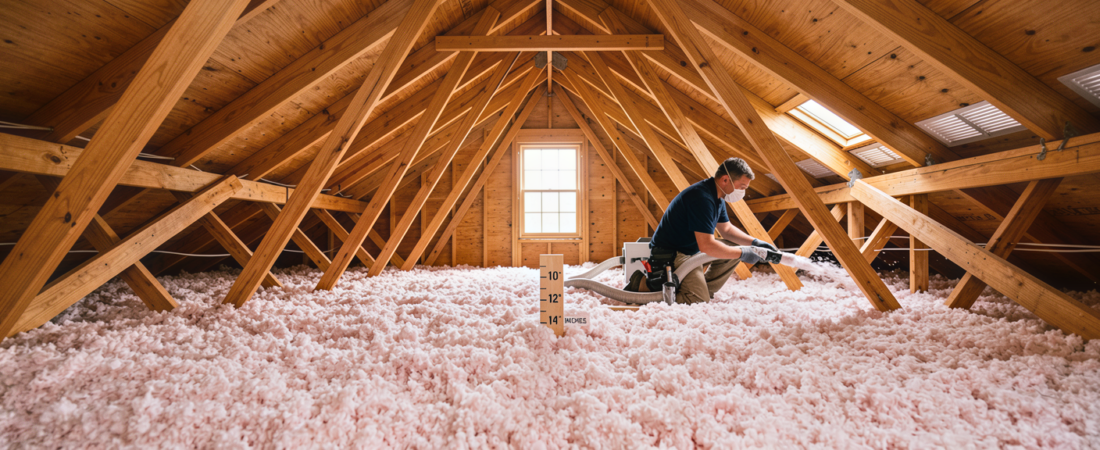
Attic blown in insulation fills gaps around joists, corners, and tight spaces, creating more even coverage than traditional insulation rolls or batts. Attic blown in insulation is loose-fill material blown across the attic floor using a special machine.
The two materials most commonly associated with this type of installation are cellulose and loose-fill fiberglass. Cellulose is generally made from processed paper fibers and is treated with fire-resistant compounds, while loose-fill fiberglass consists of fine glass fibers. Both materials are designed to slow heat movement, but their characteristics, installation requirements, and recommended depths can differ.
How Does Blown-In Attic Insulation Work?
The basic principle is simple: insulation slows the movement of heat between the conditioned living space and the unconditioned attic. In summer, it helps reduce the amount of attic heat moving downward. In winter, it helps keep heat inside the living space instead of allowing it to escape through the ceiling.
During installation, an insulation blower breaks up the loose material and pushes it through a long hose. The installer moves the hose across the attic, distributing the insulation to the desired depth. When properly installed, the material creates a relatively continuous insulating layer over the attic floor.
The effectiveness of the finished insulation depends partly on its thickness and density. This is why professional installers often use depth markers throughout the attic. These markers provide a visual reference for maintaining the intended insulation level instead of relying on appearance alone.
Why Is Attic Insulation So Important?
A significant amount of a home’s unwanted heat transfer can occur through the building envelope, including the ceiling and attic. If the attic has little insulation, warm indoor air can lose heat through the ceiling during cold weather. In hot weather, heat from the attic can move toward the rooms below.
Improving insulation can make the indoor environment more stable. You may notice that rooms beneath the attic feel less affected by outdoor temperature changes, particularly when insulation is combined with proper air sealing and adequate ventilation. The exact improvement varies considerably depending on the home’s construction, climate, existing insulation, windows, ductwork, HVAC system, and other factors.
Benefits of Attic Blown In Insulation
One major advantage of blown-in insulation is its ability to cover irregular attic surfaces. Attics are rarely perfectly open rectangles. They contain joists, pipes, wiring, framing, corners, and other obstacles. Loose-fill material can be distributed around many of these areas without requiring every section to be cut and fitted like a batt.
Another advantage is that blown-in insulation can often be installed over existing insulation when the existing material is dry, reasonably clean, and otherwise suitable for remaining in place. This can save time and avoid the mess associated with completely removing an old insulation layer.
A properly insulated attic may also help reduce the workload placed on heating and cooling equipment. When less heat moves through the ceiling, the HVAC system may not need to run as frequently to maintain the desired indoor temperature. However, insulation should be viewed as one part of overall home energy performance rather than a guarantee of a specific reduction in utility bills.
Cellulose vs. Fiberglass Blown-In Insulation
Cellulose and fiberglass are both widely used for loose-fill attic insulation, but they are not identical. Cellulose has a dense, paper-based structure and is commonly made using recycled wood or paper fibers. Fiberglass is made from glass fibers and has different handling and settling characteristics.
The better material depends on the specific project. Climate, attic design, existing insulation, installation method, desired R-value, and local building requirements can all influence the decision. Rather than choosing solely based on material price, homeowners should consider the complete installed system and whether the insulation will be properly distributed.
What Is R-Value?
R-value measures an insulation material’s resistance to heat flow. Generally, a higher R-value indicates greater resistance to heat transfer. However, the R-value needed for an attic depends on factors such as climate zone, building design, existing insulation, and local energy requirements.
This is why there is no single insulation depth that is ideal for every house. Two homes can require different insulation levels even if their attics look similar. Homeowners should check applicable local building guidance and manufacturer specifications rather than assuming that a particular number of inches automatically represents the correct insulation level.
How Deep Should Blown-In Attic Insulation Be?
The required depth depends on the material and the target R-value. As insulation becomes deeper, its ability to resist heat transfer generally increases, although the relationship is not simply a matter of adding a fixed number of inches for every desired R-value.
Manufacturers typically provide coverage charts showing how much material is required to reach particular R-values. These charts can account for factors such as installed density and material type. A professional installer should use the appropriate product specifications instead of estimating depth by eye.
Attic Air Sealing Comes First
One of the most important details homeowners sometimes overlook is air sealing. Small gaps around ceiling penetrations, wiring, plumbing, attic hatches, ducts, and other openings can allow conditioned air to move into the attic.
Adding insulation does not automatically eliminate these air leaks. In fact, covering them with loose-fill insulation can make them harder to find later. For that reason, air sealing should generally be addressed before the final insulation layer is installed.
Attic Ventilation and Blown-In Insulation
Insulation and ventilation perform different jobs, and both matter. Attic ventilation helps manage moisture and heat within an appropriately designed attic assembly, while insulation reduces heat transfer between the attic and conditioned areas.
When blown-in insulation is installed near the roof edges, it should not block designed ventilation pathways. Baffles or ventilation chutes may be used where appropriate to help maintain airflow from soffit areas into the attic. The exact ventilation strategy depends on the home’s construction and local requirements.
Can You Put Blown-In Insulation Over Old Insulation?
In many situations, new blown-in insulation can be added over existing insulation. This is particularly common when the existing material is dry, stable, and free from significant contamination or moisture problems.
However, simply covering old insulation without inspecting the attic first can create problems. Damaged insulation, water leaks, mold growth, pest contamination, or other issues should be addressed before adding new material. An attic inspection is therefore a useful first step rather than treating the project as a simple fill-and-forget job.
Can You Install Blown-In Insulation Yourself?
DIY attic insulation is possible for homeowners who are comfortable working in attic spaces and following manufacturer instructions. Blower machines may also be available through insulation suppliers or home improvement retailers, depending on the location.
The difficult part is not necessarily operating the blower. Working safely around electrical wiring, recessed lighting, roof framing, low-clearance areas, and other attic hazards requires care. Insulation must also be installed to the appropriate coverage and depth without blocking ventilation or creating problems around heat-producing equipment.
Professional Installation vs. DIY
Professional installation can make sense when the attic is difficult to access, the insulation needs to be removed, extensive air sealing is required, or the homeowner is unsure about ventilation and electrical clearances. Experienced installers can also calculate material quantities and distribute the insulation consistently.
DIY installation may be suitable for a relatively accessible attic with straightforward conditions. Even then, homeowners should read the insulation manufacturer’s instructions carefully and understand local requirements before starting. Saving money on labor is only worthwhile if the finished installation performs properly and safely.
How Much Does Blown-In Attic Insulation Cost?
The cost of blown-in attic insulation varies significantly from one project to another. The attic’s size, insulation material, desired R-value, existing insulation, accessibility, labor rates, air sealing requirements, and local market conditions can all affect the final price.
A small attic with good access and existing insulation may be considerably less expensive than a large attic requiring removal, extensive air sealing, ventilation improvements, and a thick new insulation layer. The best way to understand the actual cost is to obtain an itemized estimate that separates insulation, labor, preparation, removal, air sealing, and any additional work.
Signs Your Attic May Need More Insulation
Certain signs can suggest that an attic deserves closer inspection. Rooms directly beneath the attic may become unusually hot during summer or cold during winter, while heating and cooling equipment may appear to work harder than expected.
Another clue is visibly thin or uneven insulation. If you can easily see large portions of the attic floor or notice areas where insulation has settled significantly, the existing coverage may not meet current needs. However, visual inspection alone cannot determine the correct R-value, so measuring the existing insulation and assessing the entire attic assembly is more useful.
Common Mistakes to Avoid
One common mistake is focusing entirely on insulation depth while ignoring air leaks. Another is blocking soffit ventilation with insulation. Homeowners may also overlook recessed lights, chimneys, electrical components, attic access panels, and other areas that require appropriate clearances or protection.
Installing insulation over moisture problems is another poor approach. If a roof leak or condensation issue exists, adding more insulation does not solve the underlying cause. The attic should be dry and in suitable condition before insulation work begins.
Is Blown-In Insulation Better Than Batt Insulation?
Neither insulation type is automatically better for every attic. Blown-in insulation has an advantage when the attic contains many irregular areas because loose material can surround obstacles more easily. Batt insulation, on the other hand, comes in manufactured sections that can be convenient in accessible spaces with consistent dimensions.
Installation quality matters enormously. A carefully installed batt system can perform well, just as properly installed blown-in insulation can. Gaps, compression, poor fitting, and inadequate coverage can reduce the performance of either approach.
Does Blown-In Insulation Settle?
Some loose-fill insulation can settle after installation, depending on the material and installation conditions. Manufacturers account for expected settling when specifying coverage and required installation levels.
This is another reason professional installers use product-specific coverage information rather than simply spreading an arbitrary layer across the attic. The material should be installed according to the manufacturer’s instructions so the finished insulation achieves the intended performance over time.
How Long Does Attic Blown In Insulation Last?
Properly installed blown-in insulation can remain effective for many years. Its useful life depends on the material, attic conditions, moisture exposure, pests, disturbances, and whether later work damages or compresses the insulation.
The insulation itself is not usually something homeowners need to replace on a routine schedule. Instead, it should be inspected when there are signs of moisture, pest activity, remodeling, roof problems, or significant settling. Keeping the attic dry and protecting the insulation from unnecessary disturbance can help maintain its performance.
Does Blown-In Insulation Help With Sound?
Although attic insulation is primarily installed for thermal performance, some insulation materials can also reduce the movement of airborne sound through building assemblies. The degree of sound reduction depends on the insulation material, density, construction of the ceiling, and other parts of the home’s structure.
For homeowners considering insulation mainly for noise control, it is important to have realistic expectations. Adding insulation to an attic may help with certain sounds, but it is not a complete soundproofing solution.
What Should You Do Before Installation?
Before installing new insulation, inspect the attic carefully. Look for water stains, active leaks, damaged wiring, pest activity, mold-like growth, ventilation problems, and areas where air can escape from the living space.
It is also useful to determine how much insulation is already present and identify the target R-value for the property. Taking care of these issues first creates a better foundation for the insulation project and can prevent expensive corrections later.
Conclusion
Attic blown in insulation can be a practical upgrade for a home that has insufficient or uneven attic insulation. Its loose-fill design allows material to spread around many of the awkward shapes found in attic spaces, while cellulose and fiberglass provide commonly used options for improving resistance to heat transfer.
Still, good results depend on more than simply adding insulation. Air sealing, ventilation, moisture control, insulation depth, material selection, and installation quality all play a role. If your attic is poorly insulated, start with an inspection rather than immediately buying bags of material. Understanding the condition of the attic first can help you choose the right approach and avoid problems that become hidden once the new insulation is installed.
For many homes, the real goal is not simply having a thicker layer of insulation. It is creating a better-performing attic that keeps indoor temperatures more comfortable and reduces unnecessary heat movement throughout the year. When the work is planned carefully and installed correctly, blown-in insulation can be an important part of that improvement.
Frequently Asked Questions
Is attic blown-in insulation worth it?
Attic blown-in insulation can be worthwhile when an attic has inadequate insulation, significant heat transfer, or uneven coverage. Its value depends on the home’s existing condition, climate, energy use, installation cost, and how much improvement is needed.
How long does blown-in attic insulation last?
Properly installed blown-in insulation can last for many years without routine replacement. Problems such as moisture, pests, settling, or damage caused by later attic work can affect its condition and performance.
Can you add blown-in insulation over existing insulation?
Yes, additional loose-fill insulation can often be installed over existing insulation when the older material is dry and in acceptable condition. The attic should first be checked for moisture, contamination, damage, and other problems.
Is cellulose or fiberglass better for an attic?
Both cellulose and fiberglass are commonly used for attic insulation. The appropriate choice depends on the property’s requirements, climate, desired R-value, installation conditions, product specifications, and budget.
Does blown-in insulation reduce energy bills?
Improving attic insulation can reduce unwanted heat transfer and may lower heating and cooling demand. Actual energy savings vary because insulation is only one factor affecting a home’s overall energy consumption.