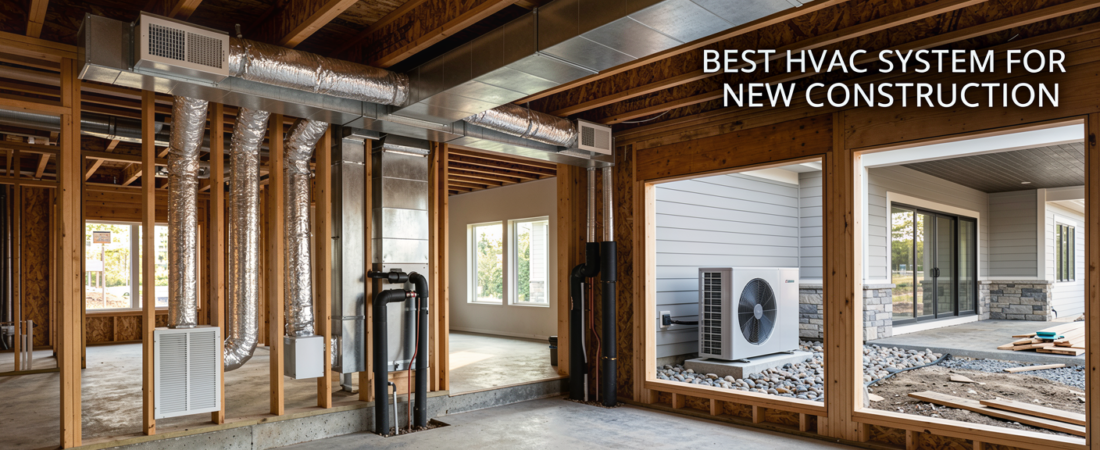
The best HVAC system for new construction, including heat pumps, central AC, ductless systems, sizing, efficiency, cost, and comfort. Heating and cooling affect comfort, indoor air quality, energy bills, noise levels, and even how efficiently the home operates over time. The good news is that building a new home gives you an advantage: you can design the HVAC system around the house instead of trying to fit new equipment into an existing layout.
For many new homes, a properly sized ducted heat pump with variable-speed technology is an excellent option because it can provide both heating and cooling from one system. However, there is no single HVAC system that is perfect for every property. Climate, house size, insulation, energy goals, available fuel, budget, and the home’s floor plan all matter.
The smartest approach is to look beyond the equipment’s brand name or advertised efficiency rating. A high-quality system that is poorly sized or badly installed can perform worse than a more modest system that has been correctly designed and commissioned.
What Is the Best HVAC System for New Construction?
For many modern new-construction homes, a high-efficiency ducted heat pump is a strong all-around choice because it can heat and cool the home using one system. Variable-speed models can also adjust their output instead of constantly running at full capacity, which can improve temperature consistency and reduce cycling. That said, homeowners in very cold climates may consider a dual-fuel system, while homes without ductwork may be better suited to ductless mini-splits. The right choice ultimately depends on the home’s design and local climate.
Why HVAC Planning Matters in a New Home
New construction gives you the opportunity to make HVAC planning part of the building process from the beginning. Ductwork can be routed through appropriate spaces, supply and return registers can be positioned properly, and equipment can be placed where maintenance is convenient. This is much easier than trying to correct design problems after drywall and finishes are already installed. Good insulation, air sealing, windows, and HVAC design should also work together rather than being treated as separate projects.
1. Ducted Heat Pump
A ducted heat pump is one of the most practical choices for many new homes. It uses a network of ducts to distribute conditioned air throughout the house and can normally provide both heating and cooling. Unlike a traditional air conditioner paired with a separate furnace, a heat pump can reverse its refrigeration cycle to provide heat. This makes it particularly appealing for homeowners who want one system capable of handling both sides of the comfort equation.
Why Choose a Heat Pump?
Heat pumps have become increasingly popular because they can provide heating and cooling without requiring separate heating and cooling equipment. Their efficiency also makes them attractive for homeowners interested in reducing energy consumption. Modern systems are available in different configurations, including variable-speed models that can operate at lower output for longer periods when conditions allow. The result can be steadier indoor temperatures and less noticeable cycling.
Variable-Speed Heat Pumps
Variable-speed technology is worth considering when comfort and efficiency are priorities. Instead of simply turning on and off, a variable-speed system can adjust its capacity to match the home’s changing needs. On a mild day, it may operate at a lower output, while it can increase capacity when outdoor conditions become more demanding. This can also help reduce temperature swings and operating noise compared with some basic single-stage systems.
2. Central Air Conditioner With a Furnace
A conventional central air-conditioning system paired with a gas furnace remains a familiar option for new construction, particularly in areas where natural gas is readily available and winter heating demand is significant. The air conditioner handles cooling during warm weather while the furnace provides heat during colder periods. This setup has been used in residential construction for decades, and many HVAC contractors are highly familiar with its installation and maintenance.
When Does a Furnace and AC Make Sense?
A furnace-and-AC combination can make sense when a home’s climate, utility availability, and homeowner preferences favor separate heating and cooling equipment. In regions with substantial winter heating requirements, a high-efficiency furnace can provide strong heating output. However, homeowners should compare the long-term operating costs and local energy prices rather than choosing a system solely because it is familiar.
3. Ductless Mini-Split Systems
Ductless mini-split systems can be an excellent solution when traditional ductwork is undesirable or when different areas of a home need independent temperature control. These systems typically use an outdoor unit connected to one or more indoor air handlers. Each indoor unit can serve a particular room or zone, allowing homeowners to customize comfort across different parts of the house.
Are Mini-Splits Good for New Construction?
Mini-splits can work particularly well in modern homes with open layouts, additions, guest suites, garages, or spaces where running conventional ducts would be difficult. They can also provide useful zoning capabilities. However, the visible indoor units may not appeal to every homeowner, and the system should be designed carefully to avoid excessive equipment or poor air distribution.
4. Geothermal Heat Pumps
Geothermal heat pumps use the relatively stable temperature of the ground as part of the heating and cooling process. They can be highly efficient, but installation usually requires more planning and a substantially higher initial investment than conventional HVAC equipment. Ground conditions, available land, drilling requirements, local regulations, and installation expertise all affect whether geothermal is practical for a particular new home.
Is Geothermal Worth It?
For some homeowners planning to stay in their property for many years, geothermal may be worth investigating because of its potential efficiency and long service life. However, the economics depend heavily on installation costs, energy prices, incentives, property conditions, and system design. It should be evaluated as a complete project rather than compared only by looking at the purchase price of the equipment.
How to Choose the Right HVAC System
The best HVAC system for a new home should be selected based on the building itself, not simply its square footage. Two houses with the same floor area can have very different heating and cooling requirements because of differences in insulation, windows, orientation, ceiling height, air leakage, occupancy, and local weather. A professional HVAC designer should perform a proper load calculation before equipment is selected.
Get a Proper Load Calculation
A heating and cooling load calculation determines how much capacity the home actually needs. In the United States, Manual J is widely used for residential load calculations. This approach considers factors such as climate, building envelope, windows, insulation, orientation, and internal heat gains. The goal is to avoid choosing equipment simply by using a rule such as “one ton per a certain number of square feet.”
Avoid Oversized HVAC Equipment
Bigger is not automatically better when it comes to HVAC equipment. An oversized air conditioner can cool the home quickly without running long enough to provide effective humidity control. It may also cycle on and off more frequently, potentially affecting comfort and equipment wear. Proper sizing allows the system to operate for appropriate periods and better match the home’s actual heating and cooling requirements.
Think About the Home’s Insulation
A new HVAC system cannot compensate for a poorly designed building envelope. Insulation and air sealing help reduce the amount of heating and cooling the home requires. This means the HVAC contractor should understand the planned insulation levels, windows, doors, building orientation, and other envelope characteristics before final equipment sizing.
Pay Attention to Ductwork
Ductwork is easy to overlook because it is hidden behind walls, ceilings, or floors. Yet it plays a major role in how effectively the HVAC system delivers conditioned air. Poorly sized, poorly sealed, or badly routed ducts can create pressure problems, uneven temperatures, energy losses, and unnecessary noise. New construction is the ideal time to design ducts properly because access is much easier before the building is finished.
Seal and Insulate the Ducts
Duct leakage can waste conditioned air before it reaches the rooms where it is needed. Proper sealing and insulation are particularly important when ducts pass through unconditioned areas such as attics, garages, crawlspaces, or exterior cavities. A good installation should minimize leakage and protect the temperature of the air as it travels through the distribution system.
Consider Zoning
Zoning allows different parts of the house to be controlled separately. This can be useful in larger homes, multistory properties, or houses where rooms have significantly different heating and cooling demands. For example, bedrooms may need different temperature settings from a rarely used guest room. Zoning can be achieved through ducted systems with appropriate controls and dampers or through multiple ductless indoor units.
Don’t Ignore Indoor Air Quality
Heating and cooling are only part of a home’s indoor environment. A new construction HVAC plan should also consider ventilation, filtration, humidity, and air movement. A tightly constructed home can benefit from a properly designed mechanical ventilation strategy that brings in outdoor air while helping maintain comfortable indoor conditions. The exact approach depends on the home’s construction and local building requirements.
Choose the Right Air Filter
A good filter helps capture airborne particles before they circulate through the home, but the filter must be compatible with the HVAC system. Extremely restrictive filtration can increase airflow resistance if the system and ductwork were not designed for it. Instead of choosing a filter solely because it has a high rating, homeowners should make sure the entire system can handle the selected filtration level.
Energy Efficiency Matters
When comparing HVAC systems, look beyond the equipment’s upfront price. Energy efficiency can influence operating costs for many years. Modern equipment uses efficiency ratings and performance metrics that vary by system type, so comparisons should be made between appropriately matched systems rather than assuming that one rating applies equally to every technology.
A more efficient system may cost more initially but could reduce energy consumption over its service life. However, the actual financial benefit depends on local utility prices, usage patterns, climate, equipment sizing, installation quality, and maintenance.
What Size HVAC System Does a New House Need?
There is no reliable HVAC size based solely on the home’s square footage. A proper load calculation should determine the required heating and cooling capacity. For example, two 2,000-square-foot houses could require different equipment if one has excellent insulation and energy-efficient windows while the other has more glass, higher ceilings, greater air leakage, or different exposure to outdoor conditions.
How Much Does a New Construction HVAC System Cost?
The cost of a new-construction HVAC system varies considerably depending on the home’s size, system type, equipment efficiency, ductwork, zoning, electrical requirements, fuel source, labor rates, and regional construction costs. A basic central system may have a very different installed cost from a variable-speed heat pump, geothermal system, or multi-zone setup. Because of this variation, homeowners should obtain detailed installation quotes that clearly identify equipment, ductwork, controls, ventilation, labor, warranties, and other project costs.
HVAC Installation Is Just as Important as Equipment
Even an excellent HVAC unit can perform poorly when installation is rushed or incorrectly designed. The contractor should verify airflow, refrigerant-related installation requirements, electrical connections, controls, duct performance, drainage, and system operation. New homeowners should also receive information about maintenance requirements, filter replacement, warranty coverage, and recommended service intervals.
Common HVAC Mistakes in New Construction
One common mistake is choosing equipment based only on price or brand recognition. Another is sizing the system according to square footage without performing a proper load calculation. Homeowners can also run into problems when ductwork is treated as an afterthought, equipment is installed in an inconvenient location, or ventilation is ignored. These decisions may not be obvious during construction, but they can become frustrating once the family moves in.
Should You Choose a Heat Pump or Furnace?
The choice between a heat pump and furnace depends largely on climate, fuel availability, energy costs, home design, and personal priorities. A heat pump can provide both heating and cooling, while a furnace-and-AC setup uses separate equipment for each function. In some colder climates, a dual-fuel system combines a heat pump with a furnace so the system can use different heating methods depending on conditions.
Best HVAC System for a Two-Story New Home
A two-story home may benefit from zoning because different floors can experience different temperatures. Warm air naturally rises, while solar exposure and room usage can also create differences between floors. A properly designed ducted system with zoning or a multi-zone approach can provide more control than treating the entire house as one large space. The HVAC designer should consider the home’s floor plan and load distribution before deciding on the final arrangement.
Best HVAC System for a Small New Home
A smaller new home may not need a large or complicated HVAC installation. A properly sized heat pump or compact ductless system can provide efficient heating and cooling when matched to the home’s actual requirements. The important thing is to avoid oversizing simply because a larger system appears more powerful. Smaller, well-insulated homes can have surprisingly low heating and cooling loads.
Best HVAC System for a Large New Home
Large homes often benefit from multiple zones or carefully designed equipment configurations. One oversized system may not distribute conditioned air evenly throughout a large or complicated floor plan. Depending on the design, multiple systems, zoning, or a combination of ducted and ductless equipment may provide better control. The solution should be based on calculated loads for individual areas rather than the home’s total square footage alone.
What Should You Ask an HVAC Contractor?
Before signing an HVAC contract for new construction, ask how the heating and cooling loads will be calculated, what equipment capacity is being proposed, how the ductwork will be designed, and how the finished system will be tested. It is also useful to ask about equipment efficiency, warranties, maintenance requirements, ventilation, filtration, zoning, and future service access. A detailed proposal is much more useful than a quote that simply lists a model and a total price.
Conclusion
The best HVAC system for new construction is not necessarily the most expensive system or the one with the highest advertised efficiency. For many homes, a properly sized variable-speed ducted heat pump offers a compelling combination of heating, cooling, efficiency, and comfort. Other homes may be better suited to a furnace and central AC, ductless mini-splits, geothermal technology, or a dual-fuel arrangement.
The biggest lesson is simple: design the HVAC system around the house, not the other way around. Start with the building envelope and a proper load calculation, then consider equipment, ductwork, zoning, ventilation, controls, and installation quality. When these pieces work together, the result is a home that feels comfortable without making the HVAC system the center of attention.
FAQs
What is the best HVAC system for a new construction home?
A properly sized high-efficiency ducted heat pump is a strong option for many new homes because it can provide both heating and cooling. However, climate, home design, energy prices, and fuel availability should determine the final choice.
Is a heat pump better than a furnace for new construction?
Neither is automatically better for every home. Heat pumps can provide heating and cooling in one system, while furnaces can be useful where strong heating output and natural gas availability are important. Climate and operating costs should be considered before choosing.
How do I size HVAC for a new construction home?
HVAC equipment should be sized using a professional heating and cooling load calculation rather than square footage alone. Factors such as insulation, windows, orientation, air leakage, climate, and occupancy can significantly affect the required capacity.
Are variable-speed HVAC systems worth it?
Variable-speed systems can provide more flexible operation and may improve temperature consistency, humidity control, efficiency, and noise performance compared with simpler systems. Whether the additional cost is worthwhile depends on the home’s design and the homeowner’s priorities.
Should new construction have HVAC zoning?
Zoning can be useful in larger, multistory, or differently oriented homes because various areas may have different heating and cooling requirements. It allows temperature control to be adjusted for separate areas rather than treating the entire home as one zone.
Read also: How Fiberglass Pipe Insulation Works and Why It Matters